
Buyer guide
How to Evaluate a Cocopeat Factory or Supplier in Indonesia
"Cocopeat factory Indonesia" is one of the most-searched phrases in this industry, and one of the least understood. This guide explains what the phrase actually buys you, what to check instead, and the questions that separate reliable supply from an attractive price list.
The short answer: whether your supplier owns the press or manages it matters far less than whether the specification is tested, the weight is checked, the packing is disciplined and the export documents are right. Evaluate the system, not the ownership structure, and this guide gives you a checklist to do it.
1. What buyers mean when they search "cocopeat factory"
Usually one of three things: a lower price by "cutting out the middleman", confidence that product is really made in Indonesia, or control over specification. All three are legitimate goals. None of them is automatically delivered by factory ownership, and all three can be delivered without it.
2. Factory ownership versus managed supply
Indonesian cocopeat reaches exporters through several structures: owner-operated factories, exporters with dedicated production partners, and traders buying spot. The practical difference is not the sign on the building. It is who controls specification and quality, and who answers when something is wrong.
For transparency: Agrorise Indonesia supplies cocopeat through selected Indonesian production partners. We coordinate the product specification, quality checks, packaging format, export documentation and shipment preparation for international buyers. We do not claim to own a factory, and we suggest treating any supplier's ownership claims as something to verify, not assume.
3. Production capacity versus quality consistency
Capacity numbers are the easiest thing to inflate and the hardest to verify. Consistency is what you actually buy: does the fifth container match the first? Ask for batch evidence across time, photographs with dates, weight records, analysis reports from more than one batch, rather than a tonnes-per-month figure.
4. EC, pH, moisture, weight and expansion checks
Five numbers govern a cocopeat transaction. Ask how each is measured, not just what the value is:
- EC, always with the laboratory extraction method named. Our own reference: 0.43 mS/cm, independently tested by SUCOFINDO.
- pH, should sit in the mid-6 range; ours tested at 6.2.
- Moisture, drives real weight and hydration; tested at 16.1% on our reference sample.
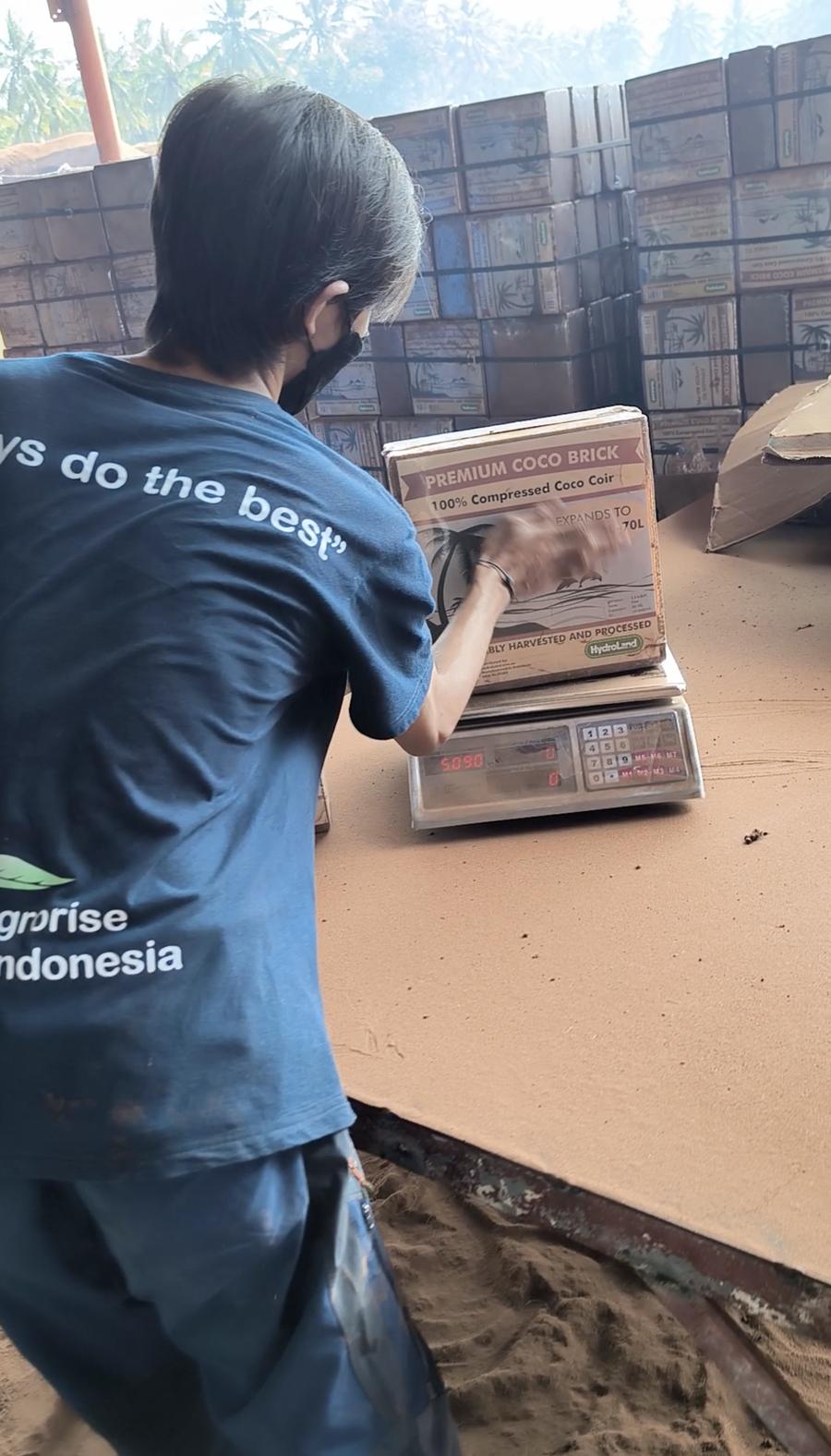
- Weight, a "5 kg block" is a claim; a scale photo is evidence.
- Expansion, ask for the method (water volume, time, resulting litres) with any figure quoted.
5. Washing, drying, screening and compression
Low EC is made, not found: washing reduces the husk's natural salts, drying sets the moisture window, screening controls particle size, and compression settings decide how a block hydrates. A supplier who cannot describe these steps in sequence has probably never stood next to them.
6. Packaging and private-label preparation
Check what the label carries (product grade, batch code, origin), whether artwork is approved before production, and how pallets are wrapped and strapped. Private-label supply is normal in this industry, the question is whether label data traces back to the packing list.
7. Palletized versus floor-loaded shipments
Palletized loading (on ISPM-15 timber) unloads fast and suits destinations with forklift labour costs; floor loading uses more of the container cube and suits hand-unload operations. Both are legitimate, what matters is that the configuration is stated in the packing list and photographed at stuffing.
8. Export documents and destination requirements
A competent Indonesian exporter prepares, at minimum: commercial invoice and packing list, bill of lading, phytosanitary certificate, and, depending on destination, certificate of origin (including preferential forms such as AANZFTA), fumigation and gas-clearance certificates, and a certificate of analysis. See our companion guide, The Documents Behind a Cocopeat Shipment, which walks through a real document set.
9. Questions to ask before a trial order
- Which laboratory issues your analysis, and can I see a recent report?
- What EC method do you quote, and what does my target convert to in your method?
- What is your weight tolerance per block, and how is it checked?
- Can I see dated stuffing photographs from a previous shipment?
- Who supervises loading, and do I receive photos of my own container?
- What happens commercially if the batch analysis misses the agreed specification?
10. How Agrorise coordinates supply and export preparation
We connect international buyers with specification-controlled cocopeat supply from Indonesia and manage the process from product preparation through export shipment: specification agreement, quality checks at production partners, packing and labeling, supervised stuffing, and the destination document set. The evidence for each step is on this site, quality control, shipment evidence, and the product pages for low EC cocopeat and the 5 kg block.
The evaluation checklist
Twelve items. A supplier who clears all twelve is worth a trial container; print this page or save it to reuse.
- Legal company identity, full legal name, address and registration you can verify independently.
- Product specification, written, complete, and stated per your order rather than generic.
- EC testing method, named method and laboratory, with a recent report shown.
- Moisture control, a stated window and how it is measured.
- Weight tolerance, per-unit target, tolerance, and checking practice.
- Expansion method, any expansion figure quoted with its test procedure.
- Packing format, wrapping, strapping and label content described precisely.
- Loading configuration, palletized or floor-loaded, stated in the packing list.
- Batch evidence, dated photographs across more than one shipment.
- Export documentation, full destination document set named before you pay.
- Communication responsibility, one accountable contact for specification and claims.
- Trial-order procedure, a sensible path from sample to first container.
RFQ · Specification-based supply
Put us through this checklist.
We built it because we can pass it. Send an RFQ and ask for any item on the list.
Prefer email? agrorise@cocopeatindo.com